- The full new State Pension is £241.30 a week. Your amount can be lower if you were contracted out before 2016, if you have fewer qualifying years on your National Insurance record, or depending on what you paid into the Additional State Pension before 2016.1
- If your record started after April 2016 you need 35 qualifying years for the full rate; if you were contracted out, usually more than 35.1 So a lower figure is often correct. It's still worth checking, because missing credits and gaps you can still fill are common and fixable.
State Pension gap and voluntary contributions
Use the weekly figure from your forecast or award letter. Nothing you type is saved or sent to analytics.
How the amount is worked out
For years from 6 April 2016 the rule is simple: with fewer than 35 such years, you get that proportion of 35 of the full rate.2 Each qualifying year is worth £6.89 a week at today's rate.
If you have years before 2016, DWP first works out a 'starting amount': the higher of what you'd have got under the old rules and under the new rules, as at April 2016.2 Each qualifying year after that adds to your pension, up to the full rate.1
If your starting amount was above the full rate, the extra is paid on top as a 'protected payment'.1 So a figure above £241.30 isn't a mistake either.
The usual reasons, and what you can do
Work down this list against your forecast or award letter. Each reason comes from GOV.UK's State Pension guidance.134
| Reason | What to do |
|---|---|
| Contracted out before 2016 (you or your employer paid less into the State Pension and more into a workplace pension) | Those years count as qualifying years, not gaps. Working on, or credits, add more; voluntary contributions may not help. |
| Fewer than 35 qualifying years since 2016, or gaps in your record | Check credits first, then whether a voluntary contribution would add anything. |
| Missing credits for bringing up children or caring | Before 2010, claim Home Responsibilities Protection; from 2010, check Child Benefit and carer's credits. |
| You paid the married women's reduced rate | You might be able to increase your new State Pension if you're eligible. |
| You live outside the EEA, Gibraltar, Switzerland or a country with a social security agreement | Your pension isn't increased each year (Canada and New Zealand get no increases). |
| A pension sharing order on divorce | Your State Pension is reduced by the shared part. |
Credits you may be missing
Home Responsibilities Protection protected the State Pension of parents and carers between 1978 and 2010. You should have got it automatically for years with Child Benefit for a child under 16, but may have missed out if your National Insurance number wasn't linked to the claim. You can still apply.3
If you reached State Pension age on or after 6 April 2010, HRP for full tax years before then was converted into National Insurance credits, up to 22 years.3
From 2010, a parent registered for Child Benefit for a child under 12 gets Class 3 credits, even without the payments; and parents who were eligible but never claimed from 7 January 2013 can apply for replacement credits when HMRC's service opens in April 2027.56
Paying voluntary contributions
You can usually pay voluntary contributions for the past 6 years, with a deadline of 5 April each year: for example, gaps in 2025/26 can be filled until 5 April 2032.7 Class 3 costs £18.40 a week in 2026/27, about £956.80 for a full year; the previous 2 tax years are charged at their original rate.7
Check before you pay. Voluntary contributions don't always increase your State Pension, for example if you were contracted out, and you shouldn't pay until HMRC writes with the amount and a payment reference.7 If you're within 6 months of State Pension age or past it, HMRC's page directs you to the International Pension Centre to check.7
You can't pay voluntary contributions if you have no gaps, if you paid the married women's reduced rate, or if the deadline for that year has passed.7
Worked example: is it worth filling gaps?
Linda's forecast is £200.00 a week, £41.30 short of the full rate. Her record shows 6 gap years she can still fill, and her forecast says each would add to her pension. At £6.89 a year, 6 years close the gap.
Six years of Class 3 at £18.40 a week cost about £5,740.80. They'd add £41.30 a week, £2,147.60 a year, so the cost is repaid in about 2.7 years of pension, before tax and before annual increases. For most people who expect to live several years past State Pension age, that's good value; for someone in poor health, less so.
Reading the forecast
The forecast tells you how much State Pension you could get, when you can get it, whether you can increase it, and how, for example by paying to fill gaps.8 A low figure at 50 isn't the end of the story if working years remain.
It also says whether you can still increase the amount, and by how much each year adds. If it says you can't increase it, paying voluntary contributions won't help, however many gaps your record shows.
Years when you were contracted out count as qualifying years and aren't gaps.1 If the forecast is lower than your number of years suggests, contracting out is a likely explanation, rather than a missing record.
Getting your figures
Under State Pension age, use the online forecast or the HMRC app; it shows how much you could get and whether you can increase it. You can't use it once you're getting your State Pension or deferring it.8 By post, fill in form BR19 or call the Future Pension Centre, if you're more than 30 days from State Pension age.8
Already getting it? Contact the Pension Service (0800 731 0469).9 Your award letter shows how the amount was worked out.
If your National Insurance record looks wrong, contact HMRC: missing years from employment or self-employment are corrected there, not by DWP.
If it's still low: Pension Credit
Pension Credit tops up weekly income to £238.00 for a single person or £363.25 for a couple, and can be more with a disability, caring or housing costs.10 A State Pension below the full rate, with little other income, is exactly the case it's for.
Check the gap
Enter your weekly forecast or award and the number of gap years you could fill. The checker shows the shortfall, the years needed, the Class 3 cost and the payback time.
Free Pension Credit calculator 2026/27 UK (free)
Before you go
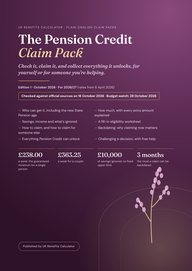
Pension Credit Claim Pack
- A one-page table of everything Pension Credit can unlock, and how to get each
- A fill-in eligibility worksheet, with worked examples
£1.99 one-off · full refund if you ask within 14 days