- The full new State Pension is £241.30 a week in 2026/27, £965.20 every 4 weeks or £12,547.60 a year.1 You need 35 qualifying years for the full rate and at least 10 to get any.2 In between, each year is worth 1/35 of the full rate, £6.89 a week.3
- From 12 April 2027 the full rate is due to rise to £250.70 a week: proposed (DWP, 11 November 2026), subject to Parliament.4
State Pension calculator
2026/27 rates. Nothing you type is saved or sent to analytics.
New or basic State Pension?
Which one you get depends on when you reach State Pension age. Men born on or after 6 April 1951 and women born on or after 6 April 1953 get the new State Pension; people born earlier get the basic State Pension.25
The full basic State Pension is £184.90 a week in 2026/27, and a married person can get up to £110.75 a week on their spouse's record.6 Most people still working will get the new State Pension, so the calculator starts there.
Qualifying years and what each is worth
A qualifying year is a tax year in which you paid enough National Insurance, or were credited with it, for example while claiming Child Benefit for a young child, caring, or on some benefits. Your record shows how many you have.7
| Qualifying years | A week | A year |
|---|---|---|
| 9 | £0.00 | £0.00 |
| 10 | £68.94 | £3,584.88 |
| 15 | £103.41 | £5,377.32 |
| 20 | £137.89 | £7,170.28 |
| 25 | £172.36 | £8,962.72 |
| 30 | £206.83 | £10,755.16 |
| 35 | £241.30 | £12,547.60 |
If you have years before April 2016
The simple 1/35 rule only applies cleanly to records that start after 6 April 2016. If you have earlier years, DWP worked out a 'starting amount' at April 2016: the higher of your pension under the old rules and under the new ones.3
Years when you were contracted out of the Additional State Pension (common in public sector and final salary jobs) usually mean you need more than 35 years for the full rate.1 And if your starting amount was above the full rate, the extra is paid on top as a protected payment.1 So for anyone with pre-2016 years, your State Pension forecast is the real figure, and this calculator is a sense check.
Worked example
Ravi started work in 2016 and will have 28 qualifying years when he reaches State Pension age. 28/35 of £241.30 is £193.04 a week, £10,038.08 a year at today's rate.
He's 7 years short of the full rate. If he can add them, by working longer, through credits, or by paying voluntary contributions, each adds £6.89 a week. At the proposed April 2027 rate the same 28 years would be worth £200.56 a week.
How to raise a low figure
Check your National Insurance record for missing credits first: they're free. Child Benefit for a child under 12, Carer's Allowance and Carer's Credit, Universal Credit and some other benefits all give credits.
Then look at voluntary contributions. Class 3 costs £18.40 a week in 2026/27, and you can usually fill gaps from the past 6 years. Don't pay until you've checked a year would actually add to your pension.8
If your State Pension is low: Pension Credit
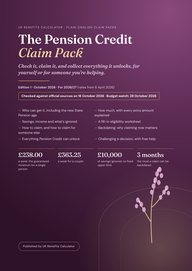
Pension Credit tops up weekly income to £238.00 for a single person or £363.25 for a couple.9 Someone on a part State Pension with little else coming in may well qualify, and it brings help with rent, council tax and heating too.
Common mistakes when estimating
Counting calendar years instead of qualifying years is the usual one. A year only counts if you earned enough, or were credited, for the whole tax year; a part-time job under the earnings threshold, a gap between contracts, or a year studying may not count unless a credit filled it.
The second is assuming 35 years always means the full rate. That's true for records that start after April 2016, but people who were contracted out often need more, because their starting amount at 2016 was lower.
The third is forgetting that the State Pension is taxable. It's paid without tax taken off, but it uses up most of your Personal Allowance, so tax on a workplace pension or earnings can be collected through your tax code instead. The figures here are before any tax.
Work out your State Pension
Choose your route, enter your qualifying years, and say whether any are from before April 2016.
Free Pension Credit calculator 2026/27 UK (free)
Before you go
Pension Credit Claim Pack
- A one-page table of everything Pension Credit can unlock, and how to get each
- A fill-in eligibility worksheet, with worked examples
£1.99 one-off · full refund if you ask within 14 days