- Opting out isn't the same as not claiming. If you opt out of Child Benefit payments you stay registered but aren't paid, so there's no tax charge to repay. You still get National Insurance credits towards your State Pension, and your child gets a National Insurance number automatically shortly before they turn 16.1
- Not registering at all loses both. That's why HMRC's advice for a new child is to send the claim form and tick the option to not have the benefit paid, even if you'd repay it all through the charge.2
Who it's for
The charge applies when you or your partner have adjusted net income over £60,000. It takes back 1% of the Child Benefit for every £200 over £60,000, and the whole amount once income reaches £80,000; if you both earn over £60,000, the one with the higher income pays.3
The law only lets you opt out if you reasonably expect that, without opting out, you or someone else would be liable to the charge for the year.4 In practice that means a household where one adult's income is, or is likely to be, over £60,000.
At £70,000, a family with two children would repay £1,168 of a full year's £2,337.40 through the charge and keep the rest. Between £60,000 and £80,000 you're always better off taking the payments and paying the charge than opting out: the charge never takes more than you were paid. Opting out mainly saves the paperwork, and above £80,000 it saves paying money back.
Why keep the claim registered
National Insurance credits. A parent or guardian registered for Child Benefit for a child under 12 gets Class 3 credits automatically, even if they don't receive the payments.5 For a parent who stays at home or works part-time on low pay, those credits can be the difference between a full State Pension and a reduced one.
Register in the right name. The credits go to the person on the claim. If that's the parent who already pays National Insurance through work, the credits may be wasted; GOV.UK lets a registered parent transfer the credits to a spouse or partner who lives with them if the parent has a qualifying year of their own.5
Other reasons HMRC gives: the claim helps you qualify for other benefits such as Guardian's Allowance, and it proves you support a child, which can mean paying less child maintenance for children who don't live with you.2
How to opt out
Use HMRC's online service or online form, or contact the Child Benefit Office by phone or post. Appointees and authorised agents can't use the online routes.1
You can't opt out while Child Benefit is being used to repay an overpayment, or certain benefits from another country.1
Opting out covers all your Child Benefit: the law lets a person elect for all payments they're entitled to not to be made, not some children and not others.4
Two duties carry on. You still owe any charge for each tax year up to the date the payments stop, and you must keep reporting changes in family life that affect entitlement.1
Opting out on a new claim, and backdating
An opt-out normally takes effect for weeks that begin after you make it.4 If the claim itself is backdated, the opt-out can also cover the backdated weeks in the 3 months before the claim, so ticking 'don't pay me' on a new claim keeps the credits for those weeks without creating a charge.4
Child Benefit weeks begin on a Monday, so changes line up with the start of a week.4
Restarting the payments
You can restart at any time if you still qualify, online, by form, or by phone or post. It can take up to 28 days to get the first payment, and the office writes to say what backdated payments there are, if any.62
From the restart date the charge applies again if your or your partner's adjusted net income is over the threshold.6
The rule that matters most is in the legislation rather than on GOV.UK. A restart normally only affects weeks after you ask. But if you opted out for a tax year and, as it turns out, no one would have been liable to the charge for that year, you can cancel the opt-out for that year up to two years after the year ends, and the payments for those weeks become due.4
Worked example: income fell below £60,000 after all
Priya expected a bonus to take her income to £68,000 in 2026/27, so she opted out of Child Benefit for her one child from the start of the tax year. The bonus wasn't paid, and with her pension contributions her adjusted net income for the year was £58,500.
Nobody in the household was liable to the charge for 2026/27, so she can cancel the opt-out for that year at any time up to 5 April 2029. A full year's Child Benefit for one child at 2026/27 rates is about £1,406.60, money she would otherwise have lost.
When a partner moves in or out
The charge follows the relationship. It applies from the date you move in together until you permanently separate or the payments stop; short spells apart, such as a hospital stay or working away, don't count as separation.2
It can also apply where someone else gets the Child Benefit for a child living with you and you contribute at least an equal amount to the child's upkeep.3 So a new partner's income can make opting out sensible, and a separation can make restarting worthwhile.
Opt out, or take the payments and pay the charge?
Below £60,000 for both adults there's nothing to decide: take the payments. Between £60,000 and £80,000 the charge is a percentage of what you were paid, so taking the payments always leaves you better off, by a shrinking margin as income rises.
At £80,000 or more the charge equals the whole payment, so the money is a loan from HMRC until the tax year's charge is settled. Opting out then avoids the round trip. If income swings around the thresholds because of bonuses, overtime or dividends, the two-year revocation rule is what makes opting out safe: you can reclaim a year that turned out to be under £60,000.
Adjusted net income is worked out after certain reliefs, such as pension contributions and Gift Aid, so extra contributions can move a household below £80,000 or £60,000.3 Run the figures before the tax year ends, not after.
Who should be the claimant
Child Benefit for a child is paid to one person only, and the credits follow that person. For a couple where one partner earns well and the other is at home or on low pay, the lower earner is usually the right claimant: they get the credits directly, and opting out doesn't change that.
If the higher earner is already the claimant, changing who claims means the other parent making a new claim. Transferring the credits is the alternative where the claimant already has a qualifying year from work.
If you never registered: replacement credits from April 2027
HMRC is introducing National Insurance replacement credits for parents and carers who were eligible for Child Benefit for a child under 12 from 7 January 2013 but didn't claim. The service has been delayed until April 2027; most people can apply when it opens.7
If you reached State Pension age on or after 6 April 2016, or will before 6 April 2027, and the delay has reduced your State Pension, you can ask HMRC to check your case through its complaints process, quoting the reference RCPC. Any payment for the delay would be made from April 2027.7
Free Child Benefit calculator 2026/27 UK (free)
Before you go
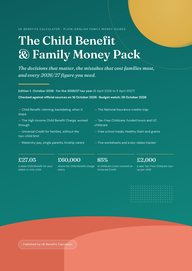
Family Money Pack
- A fill-in Child Benefit charge calculator
- A Tax-Free Childcare vs UC childcare comparison
£1.99 one-off · full refund if you ask within 14 days