- Child Benefit can be backdated for up to 3 months from the date you make the claim.1 In law the claim must be made within three months beginning with a day you were entitled, so any weeks further back than that are lost for good.2
- You can claim 48 hours after registering the birth, or as soon as a child comes to live with you.1 In 2026/27 it's £27.05 a week for the eldest child and £17.90 for each other child.3
Child Benefit backdating checker
How far back a claim reaches, and what's lost. Nothing you type is saved or sent to analytics.
Why payments start on a Monday
For Child Benefit a week runs from Monday, and the conditions are tested at the beginning of each week.4 So a baby born on a Wednesday counts from the following Monday, not the day of birth. The same applies to a child who comes to live with you.
That's also why the 3-month limit works in whole weeks: the earliest week a claim can reach is the first one starting on or after the date 3 months before the claim.
When a child came to live with you informally, the date can be hard to pin down. Use the earliest date you can show, for example from a school, nursery or GP registration letter, and give it in the claim so HMRC can test the right weeks.
Worked example
Sophie's first baby was born on 10 June 2026, but with a premature birth and weeks on the ward she didn't claim until 20 November. The first week the baby could count began 15 June 2026. A claim on 20 November reaches back only to the week starting 24 August 2026.
Nothing about the premature birth extends the limit. Had she claimed from the hospital ward in July, using her phone and sending the certificate later, every week from mid-June would have been paid.
She gets 13 weeks backdated, £351.65. The 10 earlier weeks, £270.50, are lost: there's no extension for illness or a hospital stay in the Child Benefit time limit.2
A second example: claiming in time
Marcus's stepdaughter moves in with him and his partner on Monday 2 November 2026; his partner already gets Child Benefit for their son, so the new child is paid at the £17.90 rate. Because the conditions are tested at the start of each week, the first week that counts begins 9 November 2026.
They claim on 20 November, well inside 3 months, so nothing is lost: 2 weeks are backdated, £35.80, and payments continue from then on.
Don't wait for the birth certificate
You can claim without the birth or adoption certificate. It takes longer and you may be asked to post the certificate later, but a successful claim is still backdated up to 3 months from the date you claimed.1 If you don't send the certificate when asked, you may have to start again.1
If the birth was registered outside the UK, post the original certificate and the child's passport or travel document; if you don't have them yet, claim now and send them once you do.1
Claiming even if you'll pay the tax charge
If you or your partner earn over £60,000, the High Income Child Benefit Charge takes back 1% for every £200 over, and all of it at £80,000.5 You can still claim and opt out of payments.6
Claiming matters because a parent who registers gets National Insurance credits automatically while the child is under 12, protecting their State Pension in years without enough earnings.7 If you're not earning enough to pay National Insurance while caring for a young child, a prompt claim is the simplest way to keep that year counting.
How to claim quickly
Claim online through GOV.UK, which also adds another child to an existing claim, or by post or phone if you can't use the online service.1 Have ready:
The child's birth or adoption certificate, if you have it.
Your bank or building society details.
Your National Insurance number, if you have one.
Your partner's National Insurance number, if you have a partner.
Documents you post are usually returned within 4 weeks.1 Common reasons for a late claim are waiting for the certificate, assuming the hospital registers the claim, a new partner thinking the other parent had claimed, and a child moving in informally with a grandparent or other relative. Not one of these extends the 3-month limit, so claim first and sort out the paperwork after.
If you're looking after a friend's or relative's child informally, you may be able to claim, but not usually if the council pays towards the child's accommodation or maintenance.8
Who should make the claim
Only one person can get Child Benefit for a child, so decide between you which parent claims.1 Whoever claims gets the National Insurance credits, which can fill gaps in a record for a parent who isn't working or doesn't earn enough to pay National Insurance.1
Partners can claim for different children, but if you live together only one of you can get the higher eldest-child rate. If you both claim at the higher rate, you may have to pay some back.1
A single parent, or someone on certain other benefits such as Universal Credit, can ask for weekly payments instead of every 4 weeks.3
Child Benefit, Universal Credit and the benefit cap
Child Benefit counts towards the benefit cap. If the cap applies to you, Child Benefit is still paid in full, but other benefits may be reduced.3 So a backdated award of Child Benefit can, in a capped household, mean a matching cut in Universal Credit for the same period rather than extra money overall.
Child Benefit isn't on the list of unearned income that Universal Credit counts, so outside the cap a backdated payment doesn't reduce UC.9
Twins, and more than one child at once
Each child is a separate entitlement. With twins, one is paid at the eldest-child rate and the other at £17.90 a week, and the 3-month limit applies to both in the same way, so a late claim loses the weeks for each of them.32
If you're adding a new baby to an existing claim, the same limit applies to the new child: adding them late loses the early weeks even though your claim for the older children is running.
Grandparents and other relatives bringing up a child informally face the same rule. A kinship carer who takes a child in during a family crisis often claims months later, after the dust settles; by then only the most recent 3 months can be paid.
If you think the start date is wrong
Check the award letter against the date the child arrived and the date you claimed. If HMRC has started payments later than the rules allow, for example by using the date your documents arrived rather than the date you claimed, ask for a mandatory reconsideration, usually within one month of the decision.10 Send proof of the date you claimed, such as the online submission confirmation.
Other cases
Adoption: you can claim as soon as the child comes to live with you, without waiting for the adoption to finish.8 Children 16 to 19 in approved education or training can be claimed for too, with the same 3-month backdating.81
Use the checker below with the date the child arrived and the date you claim.
Free Child Benefit calculator 2026/27 UK (free)
Before you go
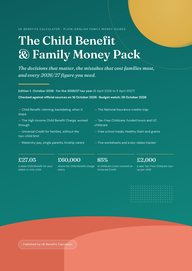
Family Money Pack
- A fill-in Child Benefit charge calculator
- A Tax-Free Childcare vs UC childcare comparison
£1.99 one-off · full refund if you ask within 14 days