- Only one person can get Child Benefit for a child.1 After a separation it normally goes to the parent the child lives with. If you can't agree, HMRC decides.1
- If the other parent is already being paid, their award keeps priority only for a short overlap: up to the third week after the week you claim. After that, a claimant with a stronger right takes over.2
- If each of you has a child living with you, you each get the eldest-child rate of £27.05 a week.3
Who has priority for Child Benefit?
After a separation, one child at a time. Nothing you type is saved or sent to analytics.
Who counts as responsible for the child
For Child Benefit you're responsible for a child in a week if either the child lives with you, or you contribute to their upkeep at least as much as the weekly Child Benefit rate.4 GOV.UK gives food, clothes or pocket money as examples of contributions, which can be in kind.1
Step-parents count as parents for Child Benefit.5 That matters for the priority rule below, where a parent beats someone who isn't one.
There's a rule that matters straight after a split. Someone who had the child living with them is still treated as living with them during an absence, unless in the previous 16 weeks they were apart for more than 56 days.4 So for the first weeks after one parent moves out, both parents can count as living with the child.
The priority order
When more than one person qualifies, Schedule 10 to the Contributions and Benefits Act sets the order. Each rule applies only if the ones above it don't settle it.2
| Rule | Who wins |
|---|---|
| 1. Existing award | The person already awarded Child Benefit, but only for weeks up to the third week after the week the new claim is made |
| 2. Living with or contributing | The person the child lives with beats a person who only contributes |
| 3. Married or civil partners living together | The woman (doesn't apply once you've separated) |
| 4. Parent or not | A parent beats someone who isn't a parent; two unmarried parents living together, the mother |
| 5. Everyone else | Whoever you jointly choose; if you can't agree, HMRC decides |
In practice: a parent the child lives with will win against a parent who pays maintenance but doesn't have the child living with them, once the 3-week overlap has passed. Where the child genuinely lives with both of you, the rules above don't separate you, so it's an agreement between you or a decision by HMRC.
Worked example: switching it over
Priya and Tom separate in September. Tom has always been the Child Benefit claimant for their two children, who stay with Priya in the family home; Tom moves to a flat and sees them on Saturdays. He pays maintenance of more than the Child Benefit rate.4
Priya claims straight away. Tom's existing award keeps priority for weeks up to the third week after the week she claims. Once Tom has been apart from the children for more than 56 days in 16 weeks he no longer counts as living with them, so Priya, with the children living with her, has priority over Tom, who only contributes.
The simplest route is for Tom to contact the Child Benefit Office to stop his claim and for Priya to make a new claim.6 Priya then gets £27.05 for the elder child and £17.90 for the younger, and the National Insurance credits for the years the younger child is under 12.37
Three common situations
Week about, or a genuinely equal split: both parents have the child living with them, so the 'living with' rule doesn't decide it, both are parents, and it comes down to whoever you choose together, or HMRC.2
A grandparent the child lives with, and a parent who sends money: the person the child lives with comes before someone who only contributes, so the grandparent has priority even though the other person is a parent.2
A parent who moved out last month: for now they may still count as living with the child, because the absence hasn't yet passed 56 days in 16 weeks.4 Claim anyway, so your claim is in place when that point passes.
Splitting the children between you
If one child lives with you and another with your ex-partner, you each claim for the child living with you, and you each get the eldest-child rate.3 If you both claim for the same child, only one of you gets it.3
When either of you later moves in with a new partner who also gets Child Benefit, only the eldest child in that new household gets the higher rate.3
The tax charge after you separate
For the High Income Child Benefit Charge, a partner is someone you're married to, in a civil partnership with or living with as if you were, and not permanently separated from.8 So once you've separated for good, your ex-partner's income no longer decides whether you pay the charge. Only your own adjusted net income, and any new partner's, counts.
The charge also applies to someone the child lives with if another person gets Child Benefit for the child and contributes at least an equal amount to their upkeep.8 The threshold is £60,000, and the charge equals the benefit at £80,000.8
Universal Credit is decided separately
The Universal Credit child element follows a different test. A child counts for the person they normally live with; if they normally live with two people who aren't a couple, only the one with main responsibility counts.9 You can nominate jointly which of you that is, but DWP can decide if you don't agree or if the nomination doesn't match the real arrangements.9
Because HMRC decides Child Benefit and DWP decides UC, make sure what you tell each matches the arrangements. Child Benefit itself isn't counted as income for UC.
Next step
Use the priority checker below for each child. If the children live with you and your ex is still being paid, claim now: weeks can be backdated up to 3 months, but the existing award holds priority only for the overlap.
Free Child Benefit calculator 2026/27 UK (free)
Before you go
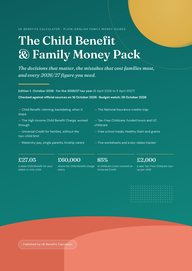
Family Money Pack
- A fill-in Child Benefit charge calculator
- A Tax-Free Childcare vs UC childcare comparison
£1.99 one-off · full refund if you ask within 14 days