- Yes. You need to have been registered as self-employed for at least 26 weeks in the 66 weeks before the week your baby is due.12 Self-employed people get between £27 and £194.32 a week for up to 39 weeks, depending on the Class 2 National Insurance contributions made in those 66 weeks.1
- HMRC's manual says the standard rate needs Class 2 paid for at least 13 of the 66 weeks; with 26 weeks of self-employment you get at least the lower rate whatever Class 2 you've paid.3 Since 6 April 2024, if your profits are at or above the small profits threshold your Class 2 is treated as paid through Self Assessment; below it you can pay voluntarily.3
Maternity Allowance test period calculator
Dates and likely weekly amount, 2026/27. Nothing you type is saved or sent to analytics.
Who this applies to
Self-employed people in England, Scotland and Wales who are pregnant or have recently had a baby, and people who do unpaid work in a spouse's or civil partner's business. Employed people can get Maternity Allowance too if they can't get Statutory Maternity Pay.1 In Northern Ireland, check nidirect.
How the test period is counted
The law looks at the 66 weeks immediately before the expected week of childbirth.2 A 'week' for this means 7 days starting on a Sunday, so the expected week starts on the Sunday on or before your due date.4 Any part of a week in self-employment counts as a week.2 The weeks don't have to be together.5
For a due date of 15 April 2027, the expected week starts on 11 April 2027. The test period runs from 4 January 2026 to 10 April 2027, and Maternity Allowance can start from 24 January 2027, the 11th week before the expected week.2
| Step | Date |
|---|---|
| Expected week of childbirth starts | 11 April 2027 |
| Test period starts | 4 January 2026 |
| Test period ends | 10 April 2027 |
| You can claim from (26 weeks pregnant, about 14 weeks before the due date) | 7 January 2027 |
| Earliest Maternity Allowance start | 24 January 2027 |
Class 2: the part that decides the amount
For the standard rate, HMRC says you need Class 2 paid for at least 13 of the 66 weeks.3 If your profits are at or above the small profits threshold, your Class 2 contributions are treated as paid to protect benefit entitlement, and in most cases enough of the test period is covered through the previous year's Self Assessment return.3
If your profits are below the threshold, you can pay Class 2 voluntarily.3 Some people need to pay before the tax year has ended to be covered in time, so contact HMRC well before your due date if you think you'll be short.3
How much you'd get: three routes
| Route | How much | How long |
|---|---|---|
| Employed (can't get SMP) or recently stopped | £194.32 a week, or 90% of average weekly earnings if that's less | Up to 39 weeks |
| Self-employed | £27 to £194.32 a week, depending on Class 2 | Up to 39 weeks |
| Unpaid work in a spouse's or civil partner's business | £27 a week | Up to 14 weeks |
Employed route example: average earnings of £180 a week give 90% = £162.00 a week, because that's less than £194.32. You must have earned £30 a week or more in at least 13 weeks of the test period.5
For the spouse or civil partner route, your partner must be registered as self-employed with HMRC and pay Class 2, and you need 26 weeks of unpaid work in the test period.15
Worked example: a self-employed hairdresser
Priya has been a self-employed hairdresser since 2024 and her baby is due on 15 April 2027. Her whole test period, 4 January 2026 to 10 April 2027, is self-employment, so she easily has 26 weeks.
Her 2025/26 profits were above the small profits threshold, so Class 2 for that year is treated as paid once her return is filed. That covers well over 13 weeks of the test period, so she should get £194.32 a week for up to 39 weeks. She can claim from about 7 January 2027 and choose to start it from 24 January 2027.
If her profits had been below the threshold, she'd be entitled to the lower rate, and could look at paying voluntary Class 2 for the weeks needed.
If the baby comes early, or you stop work late
Payments can start any time from the 11th week before the expected week up to the day after the birth.1 So if your baby arrives before the start date you chose, Maternity Allowance starts the day after the birth instead.
If you keep working right up to the birth, choose a later start date on the claim form, but don't wait to send the form: claiming early gets the decision made, and claiming more than 3 months after the start date can cost you money.
Claiming, and working while you get it
Claim on form MA1 once you've been pregnant for 26 weeks. Payments can start between the 11th week before your baby is due and the day after the birth, and to get the full amount you should claim within 3 months of the date you want it to start.1
Have proof of your due date from your midwife or GP, and your self-employment details (when you registered with HMRC and your recent Self Assessment), ready before you start. Ask DWP or check the MA1 notes about doing a small amount of work while you receive it, because working on the wrong days can affect payment.
Maternity Allowance and Universal Credit
If you get Universal Credit, it goes down by the same amount as your Maternity Allowance.1 It's still worth claiming: GOV.UK says total benefit payments usually go up or stay the same.1
If you're on UC and self-employed, tell your work coach about the pregnancy. You may also qualify for a Sure Start Maternity Grant if this is your first child.
Next steps
Put your due date into the calculator for your own test period, check your NI record for Class 2 in those weeks, then claim on MA1 from 26 weeks. If you're employed as well as self-employed, compare SMP and Maternity Allowance first.
Maternity Allowance vs Statutory Maternity Pay calculator
Before you go
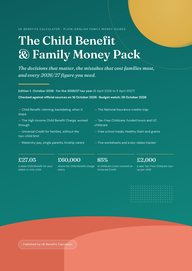
Family Money Pack
- A fill-in Child Benefit charge calculator
- A Tax-Free Childcare vs UC childcare comparison
£1.99 one-off · full refund if you ask within 14 days